
I’m a little biased, but I really enjoyed todays workout (09/30/26).
Initially the workout called for RX weights to be 95lb for men and 65lb for women. After more thought I decided to reduce the weight in order to make the workout more challenging. Yes, you read that correctly.
Two of the most important fundamental principles of CrossFit methodology are nutrition and intensity. They also happen to be the two principles that yield the most significant improvement of health.
The WOD today was a great example of how intensity is achieved. We hear the word intensity a lot, and to many it sounds a bit intimidating. “Intensity” elicits thoughts of drill sergeant like coaches yelling in your face to go faster. But this doesn’t define intensity.
Intensity is relative;
Walking is more intense than sitting on the couch.
Picking up both of your sneakers is more intense than picking up one at a time.
However very few people would categorize walking and picking up a pair of sneakers as “intense”.
We don’t arrive at intensity by choosing an option thats heavier or more challenging either. We get there by choosing something thats just heavy enough or just challenging enough.
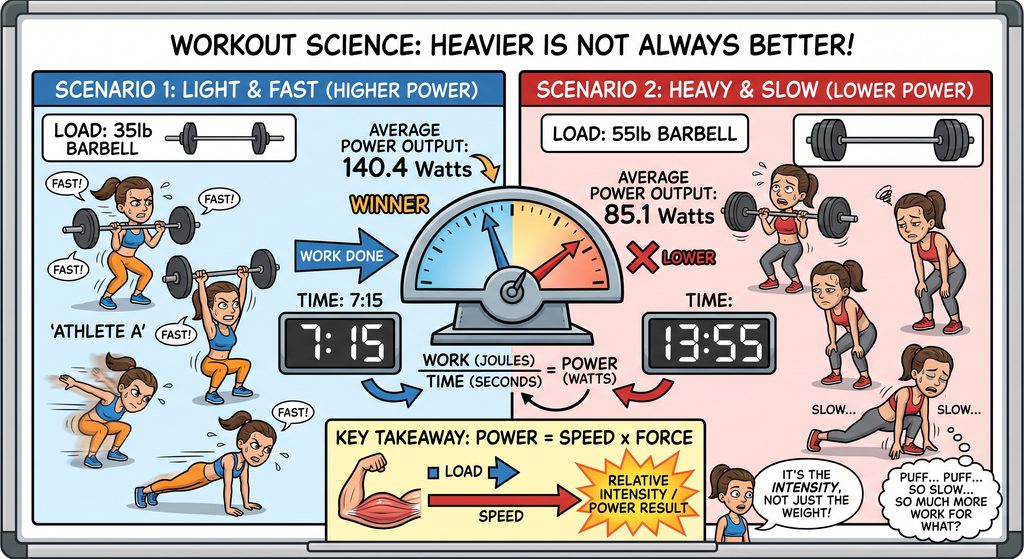
In the example below we have 2 athletes performing todays workout and in the end the lighter barbell results in more power being generated, or intensity. In order for the athlete with the 55lb barbell to achieve the same power output of 140.4 watts they would have to complete the workout in 8:26.
Side Note: From a programming perspective, variables like height and weight will also impact power output which is why I always suggest a time range. That range however should not be too broad.
Finding the “just enough” scaling option can be very difficult, which is why you come to CrossFit Spur. Our coaches are great at helping you choose the best path to the desired outcome. They watch you work out every week. They know your strengths and weaknesses, your movement flaws, your habits. Although you may not agree with the option they provide, do it and see what happens. Rarely will their suggestion result in the athlete saying “that was way too easy” or “that was way too hard” when they’re done. They have experience in finding the “intensity sweet spot” and they’re pretty darn good at it.
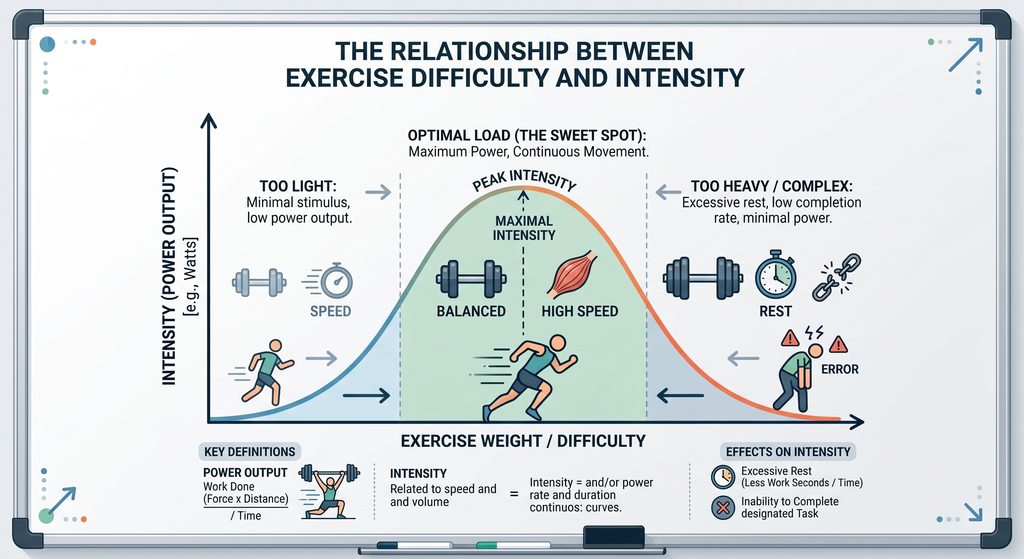
As many athletes found out today heavier doesn’t mean better. A relatively light barbell when utilized in the way the workout was designed (today, unbroken) provided an intensity many people don’t achieve nearly enough.
So, the next time you’re pondering your scaling options keep intensity in mind.
What’s the coach looking for with this workout?
What’s the best way for ME to get there?
And as always, if you’re not sure, just ask the coach!